Culture - Mumbai Boss May 15, 2013
Relic Encounters - Midday May 7, 2013
Optical illusion - Midday Apr 14, 2013
Art of the Matter - Indian Express Apr 6, 2013
Thing to do this weekend - Mumbai Boss Apr 4, 2013
Chandelier OR Creepy Smile? - Midday Apr 3, 2013
Art has always seemed natural to me - DNA Oct 30, 2012
British artist captures citys walkers - Hindustan Times Oct 24, 2012
Julian Opie Oct 23, 2012
Walk the Talk - Midday Oct 23, 2012
Julian Opie Captures The Mumbai Walker In His New Show Oct 23, 2012
Walk on - TimeOut Oct 12, 2012
Regal repose Krishna is captured asleep - TimeOut Sep 28, 2012
Navel Nagar - Times Of India Sep 22, 2012
The Visitor Sep 13, 2012
Meet the visitor from the other world - Midday Sep 12, 2012
Feast your senses on Italian art - Bombay Times Sep 7, 2012
Art pencil in it - Elle Magazine Sep 1, 2012
A taste of Italy - Indian Express Aug 30, 2012
Made In Italy Aug 25, 2012
ITALIAN ART invades Mumbai - Midday Aug 16, 2012
From south Korea to Shantiniketan - The Times of India Jul 27, 2012
The contemporary takes on classics - Midday Jul 27, 2012
Art classics get new life - Mumbai Mirror Jul 23, 2012
Two Solos - Platform Magazine Jul 20, 2012
When art is an easy buy Jun 18, 2012
Fine art for less- Mumbai Mirror Jun 4, 2012
Snap Up Affordable Art At Sakshi Gallery May 23, 2012
The only good non-human is a dead non-human - Artinfo May 8, 2012
Gods own country gets a voice on canvas - Midday May 4, 2012
Beyond the hues - The Hindu Mar 15, 2012
Home Coming - The Hindu Mar 9, 2012
My Inspiration - People Magazine Mar 1, 2012
The photographs are a different kind of novel - Tahelka Feb 24, 2012
Photos had the force, stillness books did not: Siddharth Shanghvi - Firstpost Feb 24, 2012
In a clear darkness - Hindustan Times Brunch Feb 24, 2012
Postcards from Matheran - Mumbai Boss Feb 22, 2012
Retrieving our citys lost realities - DNA Feb 19, 2012
A Personal Record - DNA Feb 14, 2012
The capital's cultural kumbh - Times of India Jan 28, 2012
The capital cultural kumbh - Times of India Jan 28, 2012
Christ & Kathakali - Times of India (Crest) Jan 7, 2012
Trending Today - Mumbai Mirror Jan 4, 2012
Recreating Identity - Indian Express Dec 23, 2011
Vivek Vilasini - An artist par excellence - Afternoon Voice Dec 20, 2011
Between One Shore and Several Others Dec 17, 2011
SHAKTI, ROOTS & A SENSE OF HUMOUR - The Crest Dec 10, 2011
The body itself becomes the celebration - Bombay Times Dec 9, 2011
The persistence of memory - Indian Express Nov 30, 2011
Pahun baga....Bagun Paha - Prahaar Nov 28, 2011
Colouring a woman - Mint Nov 26, 2011
Intangible Interlocution: An Anthology of Belonging Nov 25, 2011
Places of Rebirth Nov 4, 2011
Intangible Interlocution - Fashionfad (in focus) Nov 3, 2011
Khaki Shorts & Tinsel Plots - The Times of India (The Crest Edition) Oct 29, 2011
The other side of Celebrations - Mid-day Oct 25, 2011
Anandachi Hinsak Roopa - Prahar Newspaper Oct 22, 2011
The Anatomy of Celebration or The Party Plot Oct 13, 2011
Self Expression - Mumbai Mirror Sep 7, 2011
Click Art - Indian Express Sep 6, 2011
Deconstructing the graze - Tehelka Sep 5, 2011
Sva-rupachi matta ani pahanyatli satta - Prahaar Newspaper Sep 5, 2011
Three questions with Maya Kovskaya - Timeout Sep 2, 2011
Staging Selves: Power, Performativity & Portraiture Sep 2, 2011
Go art-hopping over thelong weekend - Hindustan Times Sep 1, 2011
The Invisible Men - The Mint Aug 27, 2011
Of motherlands and mothers - Times of India (Crest Edition) Aug 20, 2011
Trending Today - Mumbai Mirror Aug 17, 2011
The Colour of Memory - The Indian Express Aug 12, 2011
The hang of it - Time out Aug 5, 2011
The hang of it Aug 5, 2011
Art season kicks off with a group show of diverse young artist - Time Out Aug 5, 2011
The hang of it - Time Out Aug 5, 2011
Intarsia: Memory Trace Aug 4, 2011
Sunil Gawde at Pompidou Centre, Paris- Times of India Jun 25, 2011
City Art in Capital - HT-City May 9, 2011
Indian Contemporary Art - First city May 7, 2011
Tell Tale - Timeout Apr 3, 2011
Collective Nouns Apr 1, 2011
Around Town - Time Out Mar 18, 2011
The persistence of memory - DNA Mar 18, 2011
A story through time - Indian Express Mar 12, 2011
Memoirs of Tanaz and Vimala by Remen Chopra Mar 11, 2011
The Art Talk Show with Pablo - Channel News X Mar 5, 2011
When there were no hoardings - Mumbai Mirror Feb 17, 2011
A tribute to Mumbai of the 70s & 80s though the camera lens - DNA Feb 14, 2011
Costume Drama - Sunday Express Feb 13, 2011
Remembering To Forget - Sunday Expres Feb 13, 2011
Mumbai Mirror Feb 7, 2011
Remembering to Forget Jan 29, 2011
Exploring subtle expression of human mind through Family Fiction - Thane Plus Jan 8, 2011
Urban Affections - Mumbai Mirror Jan 8, 2011
Family Portraits - Time Out Jan 7, 2011
Inner Worlds - Indian Express Jan 5, 2011
INTERPLAY OF IDENTITIES - Tehelka Jan 4, 2011
Starting From Scratch. Sunday Business Standard Nov 14, 2010
Off the Wall, in Your Face - The Times of India Nov 13, 2010
Scratch and provoke - Hindustan Times Nov 13, 2010
You cannot hang this - Mint Lounge Nov 13, 2010
Scratch from the art - Hindustan Times Nov 12, 2010
Collector Choice - The Indian Express Nov 2, 2010
FINDING INDIA - Exhibition of Indian Art at the Museum Of Contemporary Art Oct 21, 2010
Painting By Amitava Oct 14, 2010
After a long gap, Amitava returns to Mumbai with a solo at Sakshi Gallery. Growing up in New Delhi, Amitava emerged in a time most remembered for political turbulence.Alongside his encounters with questions of human existence and the individual challenges of self-discovery, he has built his idiom absorbing diverse aesthetic experiences and experimenting with a multitude of media, observing and responding to surrounding events.
Roots Sep 17, 2010
Roots - DNA Newspaper Sep 17, 2010
Bangladesh Drawings by K.G Subramanyan Sep 9, 2010
These intimate sketches done on paper soon after his visit to Bangladesh are evocative of a genre that is seldom used these days.
The black and white 'notes' as it were, are vignettes of pastoral landscapes that Subramanyan is so well known for. They recall the lush landscape with paddy fields and tall palms which he glimpsed as he drove through the country. Others are sketches of over-crowded cities where rickshaws vie for space alongside plush cars and where people jostle against each other as they move to their destinations. The cacophony is audible.
Mummified Myths Aug 7, 2010
Art 41 Basel Jun 15, 2010
Carving out his own terms - DNA Newspaper May 8, 2010
Sculpture Troops - Hindustan Times May 8, 2010
Sans Divine Machines Apr 12, 2010
Time: Past, Present, Future - Bombay Time Mar 18, 2010
Alliteration Mar 17, 2010
Reunion Island - Free Press Journal Feb 10, 2010
La Isia Bonita - Mumbai Mirror Feb 10, 2010
Sakshi Gallery revisits its Roots in Chennai Jan 22, 2010
Roots - Expresso Jan 22, 2010
Roots - Metro Plus, The Hindu Jan 22, 2010
The Tradition of the New - DNA Newspaper Jan 12, 2010
The Tradition of the New - Mumbai Mirror Jan 7, 2010
Chance Encounters Apr 17, 2009
citing the city recent works by sudhir patwardhan Nov 15, 2007
Relic Encounters - Midday May 7, 2013
Optical illusion - Midday Apr 14, 2013
Art of the Matter - Indian Express Apr 6, 2013
Thing to do this weekend - Mumbai Boss Apr 4, 2013
Chandelier OR Creepy Smile? - Midday Apr 3, 2013
Art has always seemed natural to me - DNA Oct 30, 2012
British artist captures citys walkers - Hindustan Times Oct 24, 2012
Julian Opie Oct 23, 2012
Walk the Talk - Midday Oct 23, 2012
Julian Opie Captures The Mumbai Walker In His New Show Oct 23, 2012
Walk on - TimeOut Oct 12, 2012
Regal repose Krishna is captured asleep - TimeOut Sep 28, 2012
Navel Nagar - Times Of India Sep 22, 2012
The Visitor Sep 13, 2012
Meet the visitor from the other world - Midday Sep 12, 2012
Feast your senses on Italian art - Bombay Times Sep 7, 2012
A taste of Italy - Indian Express Aug 30, 2012
Made In Italy Aug 25, 2012
ITALIAN ART invades Mumbai - Midday Aug 16, 2012
From south Korea to Shantiniketan - The Times of India Jul 27, 2012
The contemporary takes on classics - Midday Jul 27, 2012
Art classics get new life - Mumbai Mirror Jul 23, 2012
Two Solos - Platform Magazine Jul 20, 2012
When art is an easy buy Jun 18, 2012
Fine art for less- Mumbai Mirror Jun 4, 2012
Snap Up Affordable Art At Sakshi Gallery May 23, 2012
The only good non-human is a dead non-human - Artinfo May 8, 2012
Gods own country gets a voice on canvas - Midday May 4, 2012
Beyond the hues - The Hindu Mar 15, 2012
Home Coming - The Hindu Mar 9, 2012
My Inspiration - People Magazine Mar 1, 2012
The photographs are a different kind of novel - Tahelka Feb 24, 2012
Photos had the force, stillness books did not: Siddharth Shanghvi - Firstpost Feb 24, 2012
In a clear darkness - Hindustan Times Brunch Feb 24, 2012
Postcards from Matheran - Mumbai Boss Feb 22, 2012
Retrieving our citys lost realities - DNA Feb 19, 2012
A Personal Record - DNA Feb 14, 2012
The capital's cultural kumbh - Times of India Jan 28, 2012
The capital cultural kumbh - Times of India Jan 28, 2012
Christ & Kathakali - Times of India (Crest) Jan 7, 2012
Trending Today - Mumbai Mirror Jan 4, 2012
Recreating Identity - Indian Express Dec 23, 2011
Vivek Vilasini - An artist par excellence - Afternoon Voice Dec 20, 2011
Between One Shore and Several Others Dec 17, 2011
SHAKTI, ROOTS & A SENSE OF HUMOUR - The Crest Dec 10, 2011
The body itself becomes the celebration - Bombay Times Dec 9, 2011
The persistence of memory - Indian Express Nov 30, 2011
Pahun baga....Bagun Paha - Prahaar Nov 28, 2011
Colouring a woman - Mint Nov 26, 2011
Intangible Interlocution: An Anthology of Belonging Nov 25, 2011
Places of Rebirth Nov 4, 2011
Intangible Interlocution - Fashionfad (in focus) Nov 3, 2011
Khaki Shorts & Tinsel Plots - The Times of India (The Crest Edition) Oct 29, 2011
The other side of Celebrations - Mid-day Oct 25, 2011
Anandachi Hinsak Roopa - Prahar Newspaper Oct 22, 2011
The Anatomy of Celebration or The Party Plot Oct 13, 2011
Self Expression - Mumbai Mirror Sep 7, 2011
Click Art - Indian Express Sep 6, 2011
Deconstructing the graze - Tehelka Sep 5, 2011
Sva-rupachi matta ani pahanyatli satta - Prahaar Newspaper Sep 5, 2011
Three questions with Maya Kovskaya - Timeout Sep 2, 2011
Staging Selves: Power, Performativity & Portraiture Sep 2, 2011
Go art-hopping over thelong weekend - Hindustan Times Sep 1, 2011
The Invisible Men - The Mint Aug 27, 2011
Of motherlands and mothers - Times of India (Crest Edition) Aug 20, 2011
Trending Today - Mumbai Mirror Aug 17, 2011
The Colour of Memory - The Indian Express Aug 12, 2011
The hang of it - Time out Aug 5, 2011
The hang of it Aug 5, 2011
Art season kicks off with a group show of diverse young artist - Time Out Aug 5, 2011
The hang of it - Time Out Aug 5, 2011
Intarsia: Memory Trace Aug 4, 2011
Sunil Gawde at Pompidou Centre, Paris- Times of India Jun 25, 2011
City Art in Capital - HT-City May 9, 2011
Indian Contemporary Art - First city May 7, 2011
Tell Tale - Timeout Apr 3, 2011
Collective Nouns Apr 1, 2011
Around Town - Time Out Mar 18, 2011
The persistence of memory - DNA Mar 18, 2011
A story through time - Indian Express Mar 12, 2011
Memoirs of Tanaz and Vimala by Remen Chopra Mar 11, 2011
The Art Talk Show with Pablo - Channel News X Mar 5, 2011
When there were no hoardings - Mumbai Mirror Feb 17, 2011
A tribute to Mumbai of the 70s & 80s though the camera lens - DNA Feb 14, 2011
Costume Drama - Sunday Express Feb 13, 2011
Remembering To Forget - Sunday Expres Feb 13, 2011
Mumbai Mirror Feb 7, 2011
Remembering to Forget Jan 29, 2011
Exploring subtle expression of human mind through Family Fiction - Thane Plus Jan 8, 2011
Urban Affections - Mumbai Mirror Jan 8, 2011
Family Portraits - Time Out Jan 7, 2011
Inner Worlds - Indian Express Jan 5, 2011
INTERPLAY OF IDENTITIES - Tehelka Jan 4, 2011
Starting From Scratch. Sunday Business Standard Nov 14, 2010
Off the Wall, in Your Face - The Times of India Nov 13, 2010
Scratch and provoke - Hindustan Times Nov 13, 2010
You cannot hang this - Mint Lounge Nov 13, 2010
Scratch from the art - Hindustan Times Nov 12, 2010
Collector Choice - The Indian Express Nov 2, 2010
FINDING INDIA - Exhibition of Indian Art at the Museum Of Contemporary Art Oct 21, 2010
FINDING INDIA
Sakshi Gallery is pleased to announce an Exhibition of Indian Art at the Museum Of Contemporary Art (MOCA), Taipei. This is the first time that such an event is taking place in Taipei. It is a major exhibition of Indian art supported by Sakshi Gallery. The show opens on 21st October, 2010 and continues till 12th December, 2010. Having consistently worked to discover and promote the best talents in the field over more than two decades, Sakshi Gallery is honoured to be associated with this seminal event.
We shall be pleased to see you all at the opening and hope that those unable to attend the opening shall visit during the course of the show. Attached herewith is a list of the participating artists and a note about the show.
For more information log on to
http://www.mocataipei.org.tw/
For further details
contact
Geetha Mehra
Sakshi Gallery
art@sakhshigallery.com
http://www.mocataipei.org.tw/
For further details
contact
Geetha Mehra
Sakshi Gallery
art@sakhshigallery.com
Sakshi Gallery
Presents
Presents
“PAINTINGS”
By
AMITAVA
From 14th October to 16th November, 2010
By
AMITAVA
From 14th October to 16th November, 2010
After a long gap, Amitava returns to Mumbai with a solo at Sakshi Gallery. Growing up in New Delhi, Amitava emerged in a time most remembered for political turbulence.Alongside his encounters with questions of human existence and the individual challenges of self-discovery, he has built his idiom absorbing diverse aesthetic experiences and experimenting with a multitude of media, observing and responding to surrounding events.
The paintings here are his recent works, with which his language responds to today’s world. At times placing divine and epic characters in a more contemporary, universal context and at times employing other forms, they point to scars of materialism and violence. And while doing so, they simultaneously stand as unique visual experiences.
The artist will be available for interaction on email and phone for the duration of the show and will be present in Mumbai from 13th to 15th October.
For further details
Please Contact:
Rajalakshmi Pandit / Maneksha Monteiro
office@sakshigallery.com
Tel: +91 (0)22 6610 3424
Please Contact:
Rajalakshmi Pandit / Maneksha Monteiro
office@sakshigallery.com
Tel: +91 (0)22 6610 3424
Roots - DNA Newspaper Sep 17, 2010
Bangladesh Drawings by K.G Subramanyan Sep 9, 2010
Sakshi Gallery
presents
Bangladesh Drawings
by K.G Subramanyan
From 9th to 30th September, 2010.
These intimate sketches done on paper soon after his visit to Bangladesh are evocative of a genre that is seldom used these days.
The black and white 'notes' as it were, are vignettes of pastoral landscapes that Subramanyan is so well known for. They recall the lush landscape with paddy fields and tall palms which he glimpsed as he drove through the country. Others are sketches of over-crowded cities where rickshaws vie for space alongside plush cars and where people jostle against each other as they move to their destinations. The cacophony is audible.
Amongst the portfolio are several portraits of men and women as he has seen them on the streets of Dacca. These quick sketches done with brisk strokes and economy of color are immediately evocative of a people typical of the region.
Despite the small scale of the drawings, we have a powerful image of a country and its people, all in black and white.
SAKSHI GALLERY
presents
Mummified Myths
Recent Works by Prantik Chattopadhyay
Dates: 7-23 August 2010
-----------------------------------------------------------
Sakshi Gallery is pleased to present ‘Mummified Myths’, an exhibition of recent works by Prantik Chattopadhyay from 7th-23rd August.
The exhibition offers a series of thought provoking works that are satirical and subtly critical in nature. Prantik works with the post-modernist language of borrowing, modifying and subverting the existing visual idioms. Advertisements and packaging form the visual sources for his works. Through his works, he creates a new interpretation of popular advertisements which subtly critique the notions of contemporary socio-eco-political conditions of the society and also infusing in them humour and irony. His innovative, witty and subversive works subscribe to a global cultural economy that thrives on clever advertising and branding. The medium for his works are watercolour and duco finished ply sheets, and found objects wrapped up in fabric as is done during mummification process.
About Prantik Chattopadhyay:
Prantik Chattopadhyay was born in 1979, Kolkota. He completed MFA in painting from M.S. University, Baroda in 2006. He has been a recipient of Nasreen Mohammedi Award in 2002. He has recently participated in Artist in Residency Programme for toy making, in collaboration with Chanapatana Toymakers, 1 Shanti Road Studio, Bangalore 2009 and in Artist in Residency Programme for site specific work at Kanakamajalu, a small village, Karnataka 2009. He lives and works in Vadodara.
Carving out his own terms - DNA Newspaper May 8, 2010
Sculpture Troops - Hindustan Times May 8, 2010
Sans Divine Machines Apr 12, 2010
Time: Past, Present, Future - Bombay Time Mar 18, 2010
Alliteration Mar 17, 2010
Sunil Gawde
Sakshi Gallery is proud to present Sunil Gawde’s magnificent installation,
‘Alliteration’ in a special exhibition from March 17 to 21, 2010. The work is
just back after being shown at the 53rd edition of the prestigious Venice
Biennale between June 7 and Nov 22 last year.
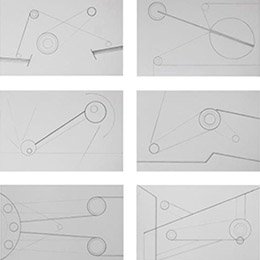
‘Alliteration’ is a 4.5 meters large dead-matte black metal kinetic piece. Its
front side presents a screen-like surface to viewers, a wall on which discs
representing 28 moons turn at variable speeds, dipping in and out of
view. The reverse side is open, naked to the eye, without hood or baffle: a
candid disclosure of the mechanism composed by seven belt-driven
wheels, which are choreographing with their movements an elaborate
dance of the moons.
‘Alliteration’ is a complex meditation on the passage of time: a
contemplation of the rhythmic flow of waxing and waning, fullness and
eclipse, which characterizes the life cycle of individuals, empires and
universes. It alludes directly to a cosmos calibrated by the interlocking
trajectories of suns, moons and planets. It hints, also, at the enigma of
personality, whether of the individual or the planet. And perhaps most
subtly, with understated eloquence, it reflects on a society that has made
the transition from an industrial past to a future in which the machine is a
splendid ruin rather than engine of profit, quiescent memorial to fortune
rather than turbulent generator of change.
‘Alliteration’ in a special exhibition from March 17 to 21, 2010. The work is
just back after being shown at the 53rd edition of the prestigious Venice
Biennale between June 7 and Nov 22 last year.
‘Alliteration’ is a 4.5 meters large dead-matte black metal kinetic piece. Its
front side presents a screen-like surface to viewers, a wall on which discs
representing 28 moons turn at variable speeds, dipping in and out of
view. The reverse side is open, naked to the eye, without hood or baffle: a
candid disclosure of the mechanism composed by seven belt-driven
wheels, which are choreographing with their movements an elaborate
dance of the moons.
‘Alliteration’ is a complex meditation on the passage of time: a
contemplation of the rhythmic flow of waxing and waning, fullness and
eclipse, which characterizes the life cycle of individuals, empires and
universes. It alludes directly to a cosmos calibrated by the interlocking
trajectories of suns, moons and planets. It hints, also, at the enigma of
personality, whether of the individual or the planet. And perhaps most
subtly, with understated eloquence, it reflects on a society that has made
the transition from an industrial past to a future in which the machine is a
splendid ruin rather than engine of profit, quiescent memorial to fortune
rather than turbulent generator of change.
About Sunil Gawde:
Sunil Gawde was born in Mumbai
in 1960. He graduated in fine art
from the Sir JJ School of Art,
Mumbai in 1980. In 1995, he
received the British Council’s
Charles Wallace Award for 1995-
1996, and spent a year as visiting
artist at the Glasgow School of
Art, Scotland. His work has been
exhibited in numerous
international exhibitions,
including ‘Radium Grass’
(Mackintosh Museum, Glasgow,
1997), Bombay Maximum City’
(Lille, 2006), ‘Made by Indians’
(St Tropez, 2006) and ‘Art on the
Corniche’ (Abu Dhabi, 2007),
organised by Galerie Enrico
Navarra. In 2009 he was invited
by Pompidou Centre, Paris for a
residency program where his work
is slated for exhibition in 2011.
His work will also be shown at the
Museum of Naples later this year
and the Museum of Athens
next year.
Sunil Gawde was born in Mumbai
in 1960. He graduated in fine art
from the Sir JJ School of Art,
Mumbai in 1980. In 1995, he
received the British Council’s
Charles Wallace Award for 1995-
1996, and spent a year as visiting
artist at the Glasgow School of
Art, Scotland. His work has been
exhibited in numerous
international exhibitions,
including ‘Radium Grass’
(Mackintosh Museum, Glasgow,
1997), Bombay Maximum City’
(Lille, 2006), ‘Made by Indians’
(St Tropez, 2006) and ‘Art on the
Corniche’ (Abu Dhabi, 2007),
organised by Galerie Enrico
Navarra. In 2009 he was invited
by Pompidou Centre, Paris for a
residency program where his work
is slated for exhibition in 2011.
His work will also be shown at the
Museum of Naples later this year
and the Museum of Athens
next year.
La Isia Bonita - Mumbai Mirror Feb 10, 2010
Sakshi Gallery revisits its Roots in Chennai Jan 22, 2010
Roots - Expresso Jan 22, 2010
Roots - Metro Plus, The Hindu Jan 22, 2010
The Tradition of the New - DNA Newspaper Jan 12, 2010
The Tradition of the New - Mumbai Mirror Jan 7, 2010
Chance Encounters Apr 17, 2009
‘Chance Encounters: Seven Contemporary Artists from Africa’ Curated by Bisi Silva Sakshi Gallery in collaboration with The Centre for Contemporary Art, Lagos (CCA, Lagos) is pleased to present its special projects initiative, “Chance Encounters, Seven Contemporary Artists from Africa” starting April 17 till May 14. Curated by Bisi Silva, the exhibition consists of works by acclaimed artists El Anatsui (Ghana), J.D. Okhai Ojeikere (Nigeria), Berry Bickle (Zimbabwe), Safaa Erruas (Morocco), Myriam Mihindou (Gabon), Nnenna Okore (Nigeria), and Uche Iroha (Nigeria). Whilst exhibitions of contemporary art from Africa have proliferated in Europe and America, few, if any have been presented in India. In keeping with Sakshi’s endeavour to introduce international art to Indian audience, we present this fantastic show and hope that it will engender a continuous journey of interaction and collaboration. “Chance Encounters” plays on the idea of discovering, meeting, interacting and exchanging within a loosely prescribed curatorial framework. It highlights the way in which individual concerns, mediums and interests coalesce into a fluid but coherent articulation of some of the important issues that affect and reflect our contemporary societies. Through different media including sculpture, painting, photography and mixed media, the artists touch on subjects of the body, memory, culture, history, colonialism, mobility, consumerism and the environment in diverse and captivating ways. El Anatsui presents three sculptural works specially created for “Chance Encounters”. Internationally acclaimed for his luxuriant, monumental sculptural installations, the works reference on the one hand a rich tradition of weaving, whilst also dovetailing into a contemporaneous consciousness about our relentless consumer society and the way in which it impacts on our environment. His works, embodied by remnants of thousands of bottle tops of local liquor drinks and are powerful symbolic reminders not only of the historical effects of global commerce and conquest, but also of the indelible characteristic of the 21st consumer society. Anatsui was born in 1944 in Ghana. He is professor of Sculpture at the Fine/Applied Arts Department, University of Nigeria, Nsukka. J.D. Okhai Ojeikere can be likened to a griot, a harbinger of history, culture and tradition. A self-taught photographer who began his career in the 1950s, the broad spectrum of Ojeikere’s work represents the richness and diversity of Nigerian and African cultural life. With a career spanning over fifty years he has documented the changing realities of a young nation from pre-independence period throughout the early euphoric post-independence period until the present. Ojeikere is, however, known internationally for his extensive photographic repository of collective hairstyle memory shown at Documenta XII in 2007. His central premise is in documenting this eroding inherited tradition and transmitting them into the present. Ojeikere’s works orchestrate the cultural signification of the African hairstyle which is marked by its outstanding sculptural form. Ojeikere was born in Ovbiomu-Emai, South-Western Nigeria in 1933. He started his career in 1953 as a darkroom assistant with the British Colonial Goverment. In the early 1970s, he opened his own studio foto ojeikere in Lagos. Safaa Erruas reduces space to its simplest form of expression through her monochromatic wall drawings, paintings, installations. Her beautiful, silent presentations are powerful artistic vehicles that use seemingly everyday objects such as needles, pins, razor, thread and silk. However, their deceptive simplicity invokes complex emotions such as pain and pleasure, injury and healing and reference issues of history, tradition and gender. As Erruas states, ‘White is not as neutral as it appears. Every colour conceals a message.’ For example the use of gauze in her work is a deeply symbolic material in her work – this thin, light almost transparent material is an important tool used in healing and in protecting from wounds and infection which Erruas uses it effectively as a metaphor for the positive, the pure against the blood red of a wound. The methodological use of white combines the emotions of purity, pain and seduction. What the artist calls ‘Le faux doux’ (false softness), in the perennial search for an equilibrium between good and bad, right and wrong which sometimes results in missing or avoiding the possibilities in-between. Erruas was born in 1976 in Tetouan, Morrocco. She studied at the National Institute of Fine Arts, Tetouan. She reduces space to its simplest form of expression through her monochromatic wall drawings, paintings, installations. Uche Iroha fuses the documentation of everyday reality as witnessed in his critically acclaimed work ‘Fire, Blood and Flesh’, producing images that reflect the dynamic forces of urban Nigerian verve in all its diversity. The series capture the reality of an abattoir the ‘hidden’ aspect of the city whilst also symbolically, posing a mental inquiry on our society today. Iroha was born in 1972 in Enugu, Nigeria. He graduated with a B.A, Sculpture from the University of Port Harcourt. He is a founding member of the collective Depth of Field (DoF). Nnenna Okore twists, weaves, flattens, ropes and braids newspapers, jute material, burlap and clay to create intricate sculptural installations which reference everyday Nigerian practices and cultural objects. She attempts to change the function, meaning, and historical or social context of the materials. By transforming ordinary materials from their original state through repetitive processes and varying textures, by employing deconstructive and reconstructive techniques, the materials inevitably assume new purposes and cultural significance. Okore was born in 1975 in Australia. She graduated with a B.A (1st Class) from the University of Nigeria, Nsukka and an MFA from the University of Iowa, USA. Berry Bickle belongs to a generation of African artists who emerged in the early 1990s when theoretical discourses about post-colonialism, cross-cultural identities and globalizations began to question the western artistic monopoly. In her work, Bickle dissects the memory of mobility to study how it impacts societies. Her work often incorporates script of different kinds, recollected fragments from the colonizers written documentations. She is most fascinated by the insignificant remains that she finds among old official documents as well as personal everyday notes such as scrapbooks, cookbooks, almanacs and diary's from life under colonial rule. The question implicit in Bickle's work is whether human beings are a community of nomadic aliens who gather personal stories to build history. Bickle was born in 1959 in Zimbabwe. She studied at the Durban Institute of Technology and Rhodes University, South Africa. Myriam Mihindou places the body, mobility and history at the centre of her diverse artistic practice in photography, video, sculpture and performance. Her photographic series Dechoucaj explores the link between the social and political situation in Haiti and the African continent, what the artists calls, ‘the transfer of a reality between history spectre and the index’. By presenting her images in negative black and white Mihindou wants to establish a connection between the African continent’s ties with contemporary history and the future of this chaotic territory which is Haiti. Mihindou was born in 1964 in Libreville, Gabon. She graduated in Fine Art from the School of Fine Art in Bordeaux, France. Bisi Silva is the director/founder of the Centre for Contemporary Art, Lagos and an independent curator. Among her projects includes co-curator, Dak’Art Biennale (2006), “Democrazy: Three solo exhibitions and a publication”,(2008). Like a Virgin… Lucy Azubuike & Zanele Muholi (2009). She is a curator of the 2nd Thessaloniki Biennale of Contemporary Art, Greece in May 2009. Details: Date: April 17 – May 14 Venue: Sakshi Gallery, Tanna House, 11-A, Nathalal Parekh Marg, Colaba, Mumbai-400001 T: (022) 66103424 W: www.sakshigallery.com For further information, contact: Sanyogita Deo E: sanyogita@sakshigallery.com T: (022) 6610 3424
Sakshi Gallery is proud to present the works of one of India’s leading contemporary artists - Sudhir Patwardhan. The exhibition ‘Citing the City’ opens at Sakshi Gallery on 15th November and will be on view till 27th November .The exhibition will subsequently travel from Mumbai to Kolkata and then from Delhi to Vadodara thus covering all the major art centers of India.
There have been a number of fascinating parallels which have been drawn between physical, psychological and social conditions of contemporary urban society and the works of arts by artists that represent the reality in a transparent manner.
Sudhir Patwardhan’s bodies of works are examples of this constant dialogue between ‘Art’ and ‘Society’. His paintings allow viewers a panoramic view with multiple perspectives. The urban milieu of rapid transformation, alienation, dislocation and anonymity are explored with finesse in his works.
Sudhir Patwardhan’s paintings and drawings of urban landscapes are snapshots of events in the life of its dwellers. They reflect the psychological fear lurking in the deepest recess in the minds of its inhabitants – the insecurities keeping them on the edge – ready to pick up fights at the slightest provocation or nonchalance to be totally immune to violence around them. Mumbai as ‘Maximum City’ is truly reflected in Sudhir’s oeuvre.
Sudhir Patwardhan was born in Pune in 1949.He started exhibiting his works from 1974.He has held several highly acclaimed solo and group exhibitions in Mumbai, New Delhi, Kolkata, Bangalore and Vadodara. He has participated in several important international exhibitions of contemporary Indian art in UK, Europe, America and Japan. He lives and works in Thane, Mumbai.
Recent works by Raj Kumar Oct 18, 2007Sakshi Gallery is proud to present recent works by Rajkumar. The show will open on 18th October 2007 from 6.30 pm to 8.30 pm.
Rajkumar will show his sculptures in wood and paintings on paper. His work is very much rooted in the folk and tribal idiom of Bastar where he lives. Though the language is traditional and from the area, his imagery and narration is very contemporary and born out of his day to day experiences both in the surrounding villages and the big cities that he visits now and again. He is able to see humor in the activities of daily life and is able to infuse them with an energy all his own.
Rajkumar has participated in a number of exhibitions across the world including the recently concluded 'Edge of Desire' mounted by the Asia Society, New York.
The exhibition will be on view till 28th October 2007 from 11 am to 7 pm(Except on Sundays and public holidays).
a preview of nalini malani's recent paintings Jul 10, 2007Sakshi Gallery is proud to preview a selection of works by Nalini Malani before her solo in the Irish Museum of Modern Art, Dublin
Preview: Opens on 10th May 2007
On view till 11th to 12th May 2007
A Note on Nalini Malani’s solo show from the official website of the Irish Museum of Modern Museum, Dublin
NALINI MALANI
Solo Exhibition at the Irish Museum of Modern Art, Dublin
11 July 2007 – 14 October 2007
Curated by the Director Enrique Juncosa
This exhibition, the first solo show in Europe by Nalini Malani, one of India’s most prominent artists, comprises paintings, installations, video and performance. Known for her politically charged work, Malani has gained an international reputation for seeking to reposition the traditional content of Indian art within a contemporary media-based format. Malani’s work reflects a deep commitment to women's issues, particularly with regard to social and family relationships in which women's skills often go unappreciated. Ancient Greek and Hindu epics, and modern European drama, give additional subtext to Malani’s complex, layered surfaces. The exhibition includes four groups of works dedicated to different female figures from Western and Indian culture – Medea, from the plays of Euripides; Alice from Alice in Wonderland; the Goddess Sita from the Ramayana one of Hinduism’s greatest epics; and the 12th-century poet Mahadevi Akka. The lives of women, the predicaments of gender, and the struggle for voice and power feature prominently in her works.
Born in 1946 in Karachi, which is now in Pakistan, Malani trained as a painter and received her Fine Arts degree from the Sir J J School of Art, Bombay, in 1969. She has exhibited widely and has had residencies in both the US and Europe. Recent solo shows include the New Museum of Contemporary Art in New York, 2002/03, and the Peabody Essex Museum in Salem, Massachusetts, 2005. Her works were also included in the recent landmark international exhibitions Century City, Tate Modern, London, 2001, and Unpacking Europe, Museum Boijmans van Beuningen, Rotterdam, the Netherlands, 2001. She has participated in the recent biennales of Istanbul, 2003, Seoul, 2004, and Venice, 2007. Malani lives and works in Mumbai, formerly Bombay.
The exhibition is accompanied by a substantial catalogue published by IMMA in association with Charta, Milan. It includes texts by Dr Chaitanya Sambrani, art historian, curator and writer; Thomas McEvilley, Professor of Art History at the School of Visual Arts, New York; Enrique Juncosa, Director, IMMA; and an interview with the artist by curator and art historian Johan Pijnappel.
recent works by valay shende May 31, 2007Sakshi Gallery is proud to present the recent works by Valay Shende. The show will open on 31st May 2007 at 6.30 pm to 8.30 pm.
Valay’s recent works are in subtle ways his attempts to question the maladies afflicting urban society and humans today. He is a keen and sensitive observer of his surroundings and concerned about the common man’s trial and tribulations of day-to-day life.
Valay feels an artist owes a responsibility to the society and firmly believes an ideal world can be re-created. He wishes the audience to reflect upon the social issues plaguing man today.
Valay primarily creates video works and sculptural installations. His observations and feelings set off the production of his work and hence determine the choice of media. His works demonstrate his technical deftness and ability to transform a thought into a work of art.
Valay was born in 1980 in Nagpur. He completed his BFA in Sculpture from Sir J.J. School of Art in 2004. He has since exhibited in India and abroad. He has participated in an artist residency programme at Point Ephemere in Paris. He has exhibited in Havana Biennale, ‘Bombay Maximum City’ at Lille 3000, and ‘Made by Indians’ at St Tropez Beach in France. He lives and works in Mumbai.
The exhibition will be on view till 30th June 2007 from 11 am to 6 pm.
vasudha thozhur, paintings from 2001 to 2007 Apr 23, 2007Sakshi Gallery is proud to present works of Vasudha Thozhur – 2001 to 2007. The show opens on 23rd April 2007 and will be on view till 5th May 2007.
Vasudha Thozhur’s paintings comprise of dissonances, criss-crossing the territory between abstraction and figuration, colour and form; and the predominant structure is one of juxtaposition. She creates a world of subtle tonalities, with a corresponding mutation in visual impact; but one sees that this is in fact an elaboration of the same tendencies, further evolved through time. Located within the experiential, and handled with a painterly sensibility, representation of the real is deployed as a tool, its literalness facilitating its use as visual text. Colour appears as light, in the medieval strategy of controlled areas of brilliant illumination; particularly readable through the use of symbols or imagery drawn from popular memory. Her paintings provide a stage for the occasional appearance of the human figure in the form of a self-image or of other significant players in her life. The scale allows the necessary physical entry, while an unfolding drama proceeds in panels of differing visual codes and languages. In her own words, “ Change and time are essential components which are physically incorporated into the work like pieces of grit in an oyster shell, visually and visibly transforming it without weakening the logic of the processes at work.” The appearance of herself in her paintings blurs the boundaries between the inner and outer realties, art and life, invention and circumstance, in a paradoxical attempt to defy and seek division, and to define this attempt and the grey areas that it engenders.
To quote the artist “ In the painting - the self-image framed within the context of widowhood / sacrifice /loss of sexuality through the shaving of one's hair - part of a group of four, with the peacock as the central motif. The first panel is a piece of text; a letter, to be precise, in vermilion and gold. The second panel is based on a press photograph, which appeared in the newspapers during the months after the earthquake in Gujarat, of a man whose hair is being shaved off by a barber in preparation for rituals of death and mourning. I have substituted my own image for his in the painting.
The third panel is a painting of a peacock.
As for the fourth - one of the most moving stories that I read early in 2001, during the aftermath
of the earthquake, was of a young girl who was crushed under the debris of her own home. As
rescuers toiled to pull her out, she scratched a plea on her bare leg, with a piece of the rubble – do not stop one who wishes to go.
The peacock as a national/notional bird is an intended cliché, I recalled later the fact of his being
male. There are two broad aspects to this panel one is personal loss, the other is the nation, or
rather the play of forces that seeks to define it in exclusive terms - embodied by the aggressive
display of opulent plumage, and the seduction that it intends.”
Vasudha Thozhur was born in Mysore in 1956. She studied painting at the College of Arts and Crafts in Chennai and at the School of Art and Design in Croydon, U.K. She lives and works in Baroda. She travels, teaches, lectures and writes on occasion for catalogues.
* Extracted from the catalogue essay written by Vasudha Thozhur
connexion recent works by sachin karne Mar 29, 2007Sakshi Gallery presents ‘Connexion’ an exhibition of recent paintings by Sachin Karne at Shridharani Gallery, Triveni Kala Sangam, New Delhi. The show opens on 29th March 2007 and will be on view till 5th April 2007.
Sachin’s recent paintings are “A new balance of the personal and the political often resulting in a revelation of a loss of ground. Detachment is ok, but with it comes a sense that you belong nowhere. Some overcome it as they rework their positions, to get a better view of the landscape of life.
Sachin Karne’s new work speaks of the havoc that is played with our lives. The artist does not take us on a guided tour to those havocs, though. He instead picks one such incident, the destruction of the Buddha statues at Bamyan. It was most disturbing… a prelude to more destruction and a marked beginning of a tragedy, asserts Sachin. The Buddhas were destroyed in early 2001, while Sachin painted the incident much later, in 2006, when he returned from a sojourn to Laddakh. By that time, the immediate wounds of those magnificent Gandhara edifices could have been blurred, and Sachin’s own experience of a burning Baroda through the 2002 riots in Gujarat might have taken a back seat. One needed this distance from the course of events, to relocate them in the course of life.
Such relocations are visible in more ways than one, in Sachin’s recent works. To be sure, the artist was always at ease with the churning of ideas and visual readings. His narrative unfolded cryptically with a juxtaposition of images. Sachin felt a need to shift his focus to a larger terrain. Earlier, he celebrated the dilemma of dualities.
His recent work attempts to solve the riddles caused by such dilemma.”
Sachin Karne born in 1965 in Pune. He studied painting in Pune and at Faculty of Fine Arts, M.S.University of Baroda. He lives and works in Baroda.
* Excerpts from the catalogue essay written by Abhijit Tamhane
Recent paintings by Rajeswara rao Mar 23, 2007Sakshi Gallery, Mumbai is happy to present recent paintings by A. Rajeswara Rao at Tanna House, Colaba. The show will open on 23rd March 2007 at 6.30 pm and will be on view till 5th April 2007.
Rajeswara Rao’s art has had an intensely symbiotic relationship with the immediacy of life as it is happening and shaping around him. Somewhere between his own experiences, his keen observation of people in the environment and a more distanced reflection, his painting appears to be evolving in an almost organic response to these factors. Primarily, the artist registers the exuberant kaleidoscope of ordinary, tough often extraordinarily fascinating, human behaviour, aspirations and desires, emotions as well as fantasies and pretences, all being evident, even flaunted with pride and put on display, on city roads and in domestic spaces, all set amid the paraphernalia of today’s popular culture.
Rajeswara indulges in documenting this reality, or rather in capturing slight but succinct glimpses of it which together add to a broad vista that is also filtered and overstressed through his personal feelings and thoughts. Thus, this sympathetic onlooker admits the innocence, excitement, sensuous energy and simple joys of his characters while noticing their certain naivety, crudeness and rapacity or social imperfections. Since both these sets of qualities normally go along, he acquires as though the role of a lenient judge without a necessity to pronounce verdicts, one who cherishes the vitality surrounding him and who is amused by its extreme or quaint manifestations. Consequently then, the affirmative delight of his imagery mingles with the humour that belongs to unadorned, if not very critical, frankness, whilst notes of lyricism resurface from the partly autobiographical layers of this scenery. *
A.Rajeswara Rao was born in Andhra Pradesh in 1960. He studied Fine Arts at the Andhra University and completed his Masters in Fine Arts from Central University, Hyderabad. He lives and works in Hyderabad.
Sakshi Gallery moves to the Art District Feb 19, 2007Welcome to our new space at Colaba. From 19th February 2007, Sakshi will have a new address. Situated in the leafy tree lined avenue Nathalal Parekh Marg on the ground floor of an old quintessentially Colaba building with its own garden and portico. Sakshi Gallery will open with a group show of the artists with whom the gallery has had a long and abiding relationship, some of them, since its inception in 1984.
With this timely move, Sakshi will be located in the heart of what is fast becoming the "art district" of Mumbai with over 20 odd art galleries and design stores in the vicinity. Sakshi has always been at the helm of affairs with its pulse on the Indian art world; constantly reinventing and adapting to the demands of the ever-vibrant art scene and art practice. When we had a sense that artists were ready to explore new materials and experiment with scale and volume, we moved from our upmarket Altamount Road space to the sprawling Shree Ram Mills in industrial Lower Parel in order to provide a ready platform and to witness at first hand the transformation which was to take place in the art world. Artists began to make good use of our space all of the 10,000 sq ft with its 60 ft height. Works became more ambitious and far more experimental. Here was a space, which lent itself to video installations, performances, interactive and dynamic work. Some of the cutting edge shows we had were:
Sudarshan Shetty’s “A Brisk Walk Makes You Feel Good” in 1999
Vivan Sundaram’s “Shelter” in 1999- 2000
Atul Dodiya’s “Lives and Works in Mumbai” in 2002
Navjot’s “Jagar and Water Weaving” in 2002
Sunil Gawde’s “Blind Bulb” in 2005
Riyas Komu’s “ Faith Accompli” in 2006
The Sakshi space has been equally welcoming of two-dimensional "art on the wall”. It has been the venue of some important painting shows such K G Subramanyan’s exhibition in 2005, Sudhir Patwardhan’s solo show in 2004, Manjit Bawa’s touring exhibition in 2004, which travelled to Mumbai, New Delhi and Baroda.
Over the last 20 years, Sakshi Gallery has held exhibitions the world over: in Berlin, Hong Kong, New York and London, Singapore and also within India in Delhi, Baroda, Calcutta, Bangalore, Chennai and Hyderabad.
Sakshi Gallery was the first multi-location gallery in India with spaces in Mumbai, Bangalore and Chennai. Ten years ago it consolidated under one roof in Mumbai; all of 10,000 sq.ft, making it the largest private gallery in the country. Sakshi Gallery has debuted many a young artist and has, in equal measure, enjoyed the support of some of India’s leading artists like K.G. Subramanyan, F.N. Souza, Manjit Bawa, Nalini Malani, Bhupen Khakkar, Jehangir Sabavala, Gulam Mohammad Sheikh, Jogen Chowdhury, Sudhir Patwardhan, Navjot, Nilima Sheikh and others.
Artists that we have built up a close association with are Amitava Das, Anandajit Ray, Anita Dube, Anjum Singh, Ashim Purkayastha, Dhruva Mistry, Gurusiddappa, Manisha Parekh, Rajeswara Rao, Ravinder Reddy, Rekha Rodwittiya, Riyas Komu, Sachin Karne, Shibu Natesan, Subodh Gupta, Sumedh Rajendran, Sunil Gawde, Surendran Nair and Vasudha Thozur.
The gallery has an art advisory section, an art lending library for corporate houses and undertakes large public commissions besides supporting students and young artists with scholarships.
Our inaugural show will be on view till 25th February 2007.
Sakshi Gallery
Synergy Art Foundation Ltd
Tanna House, Ground Floor
11-A Nathalal Parekh Marg
Near Regal Cinema, Colaba
Mumbai 400 001
+91 22 6610 3424
Once upon a time….by Rekha Rodwittiya Oct 12, 2006Sakshi Gallery presents Rekha Rodwittiya’s paintings titled “Once upon a time….” at Shridharani Gallery, Triveni Kala Sangam, New Delhi. The show will open on 12th October 2006 at 6.30 pm till 8.30 pm.
In Rekha’s words, “There are hundreds of stories that each of us carry with us. These stories are an amalgamation of truths and desires, memories and histories that are the residues of experience, which form the patina of our psyches and define our personas. At forty-eight, I caught myself in reverie, looking at the orbit of my own life to examine it. I think it is accurate to say that as painters we often chronicle through our art, and in doing so, create spaces to recount what we have garnered through the prisms of personal journeys, and via our encounters with the social, political and the cultural.
“Once upon a time…” alludes to both these personal and collective territories that I inhabit, which are the yin and yang of my existence. This “sequence of paintings” that constitutes the rhythm of this exhibition, forms a metaphorical bracket within which the autobiographical is hinted at obliquely; locating birth, childhood, identity, gender-politics, hybridity, motherhood and other nuanced factors of a witnessed world, to be examined and mulled over. However at no time are these paintings illustrative stories about my life. Metaphors are always culled from specific sources of reference, but transform by virtue of how they are finally delivered, to evoke wider meanings. These paintings explore the cycle of life and are a homage to the ancestry of womanhood, in which the presence of my persona becomes merely its emblematic representation.
Within the structure of this event I have chosen to present a book of essays and photographs titled “…and they lived happily ever after”, in the space that is otherwise occupied by the conventions of a catalogue. This book is autobiographical and the photographs, a documentation of my genealogy. It is these two components of the show, the paintings and the book, which make up the entire territory of the exhibition; both independent factors, yet functioning like two sides of the same coin”.
Rekha Rodwittiya was born in 1958 in Bangalore and studied painting in the Faculty of Fine Arts, Baroda and at the Royal College of Art in London. She has participated in several exhibitions in India and abroad, and her work is in major collections.
The exhibition is on view till 19th October 2006 from 11 am to 6 pm.
black spring of the blue god by amit ambalal Oct 5, 2006Sakshi Gallery is happy to present Amit Ambalal’s paintings titled “Black Spring of the Blue God”, a preview of paintings from 24th August 2006 to 28th August 2006. This show in collaboration with Gallery Maya will be exhibited at Air Gallery, London in October 2006.
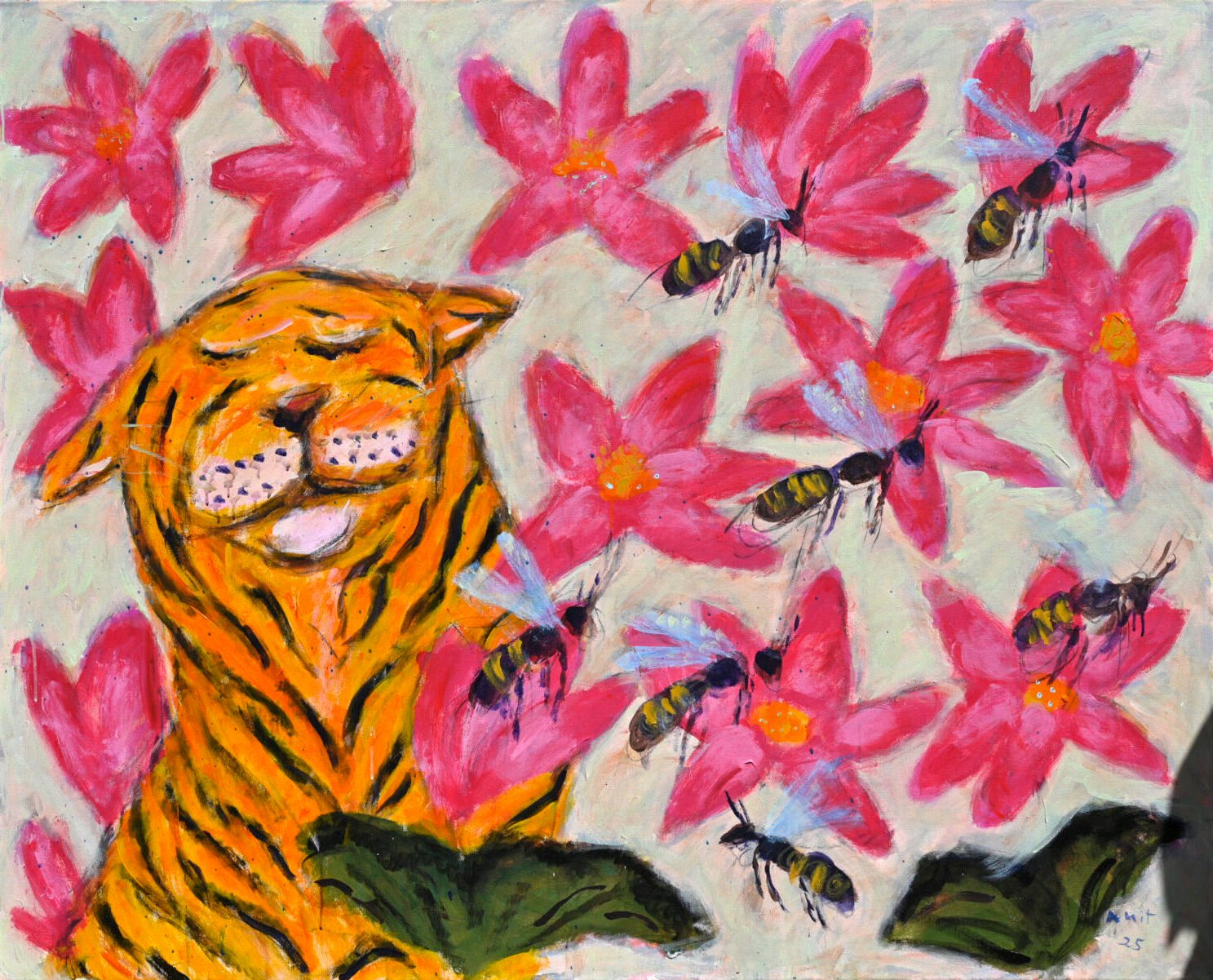
In the current series of Amit Ambalal’s paintings the cuckoo and the crow are like consummate performers, who slip easily out of one role into another, playing out the entire theatre of human vanity. For Amit, the crow assumes near human dimensions. The artist says, “We have so many tales, fables, myths and legends which portray him as a trickster, bhakta or one who is associated with ancestors”. His commitment to the concept of leela, or play is rooted as much in his research on the representation of Krishna as Shrinathji as in his own observation of the banal and commonplace. Perhaps as a first step in his symbolic use of the crow and darkness, Amit plays with the idea of Krishna the dark one. Amit’s choice of the crow is already loaded with the legacy of such associations. Thus the crow postures, much like a contemporary godman, or the politician, under the arc lights of the mass media.
In nearly three decades of painting, Amit Ambalal has devised a panoply of characters, human and animal, that completely upturns the ideal of the moral, the upright and the good. In his penumbra of characters that appear to leap and contort out of the pages of Aesop or the Panchatantra, or even the dense forests of India where the Jataka stories were played out, the defining mark is the aspect of leela. Amit Ambalal’s art of satiric inversions is complex and richly narrativist. Myth may provide some of the symbolic atmospherics, but the artist’s language is persistently modern. In this particular series, through his constant referent, the crow and the cuckoo, he sets up a mercurial dialogue between the lyrical and the raucous, the male and the female, the deceptive and the playful. As the allegorical encounter spins itself out, he reveals through gentle asides the rich undertow of mythic referents in Indian public life, now rendered with a contemporary flourish.
Amit Ambalal, coming from a family of business scions, quit that profession in 1979 to full time engagement with painting, a passion nurtured from young age. He has had no formal art training, but was guided by veteran artist and teacher Chhaganlal Jadav. Today he is known as a patron, scholar and practicing artist. He lives and works in Ahmedabad. *
* Extracted from the forthcoming exhibition catalogue written by Gayatri Sinha
feed, new works by arunkumar h.g Sep 26, 2006Sakshi Gallery in collaboration with Nature Morte presents “Feed”, new works by Arunkumar HG. The show opens on 26th September 2006 at 6.30 pm and will be on view till 7th October 2006.
Arunkumar H G was born in 1968 in Karnataka. He completed his bachelors and masters degree in sculpture from M.S.University of Baroda in 1995. He has exhibited his works in India and abroad and also participated in several artists’ residencies and workshops in and outside the country.
“Some of his scenes depict the common but unexpected view of workers taking a break, taking their lunches at a nondescript place. These spaces and scenarios are the background in which a possible argument of consumption begins.
Arunkumar sources the other sides of the theme from within the fold of materials and not descriptions. If they are to be described they have to be forced upon, which would be a violence upon a prospective violence already present.
The most interesting in the thematic are the double-ended portrayals of the animals, and the mutant human family. The animals are no Magdeburg mutants trying to test out the strength of a third object but are creatures of destiny from the hinterlands of industrial cities. Then there are the unfamiliar creatures, part of a series called “Feed”, watching- live television. Thus fed continuously, they transform into the mutant families that are the present-day entities, creatures of destiny trapped in a media age, caught within the networks of the entertainment industry, abysmally uncertain, but certainly on an asymmetrical receiving end’.
(Excerpts from Anshuman Dasgupta’s essay on Arunkumar’s Feed)
Labour : Installations by Narendra Yadav Jul 26, 2006Opening on Wednesday 26th July 2006
On view till 5th August 2006
At The Museum Gallery
Labour : Installations by Narendra Yadav
Persistence of vision is an ability of the human brain to connect motion
of seemingly disjointed nature into something that makes sense.
That means, if you blink and see the left foot ahead of the right foot
and next blink you see the right foot ahead of the left,
your brain puts it together as running.
Narendra Yadav blinks quite a lot.
Perhaps, that is why he is blessed with such persistence of vision
as to open his first solo at 40, an age where most people have given up
all semblance of any ambition.
And if you blink through his line-up of quaint, ironic and questioning objects,
put together in mixed media, multimedia, living media, your brain too might connect the various discrete images into an apparent continuity,
something that makes sense.
Naren does not try to give you a clue as to his origins or his leanings.
He simply observes, and while you are unraveling his observations you might be deceived into believing it’s him at your shoulder muttering that faint contemplative ‘hmmm’.
It will surprise you to hear this voice.
For in the babble of vagueness and ambient sound that emanates from
most galleries, Naren’s voice can be heard distinctly.
Not because, it is loud or colourful or assertive.
Simply because, under all that sourness, cynicism, wittiness
there’s a gentleness, that embodies supreme tolerance towards the world,
its inhabitants and its commentators.
Even the title suitably underplays any sense of achievement
or accomplishment. Its Naren’s work and what else to call it but ‘Labour’.
You might come out of the hall with the same sense of wonder at the world,
that Naren has, and maybe it’s not the sun that’s making you blink.
Narendra Yadav lives and works out of Mumbai.
For details Narendra Yadav – 98200 39105
Pallavi 022 24910728/29